
If you’ve been following the AI world even casually, you probably know that writing software code is one of the things AI has gotten surprisingly good at. There’s a whole new category of tools that help developers write, fix, and test their code using artificial intelligence. And this week, one of the biggest names in tech just put serious money behind the most popular one.
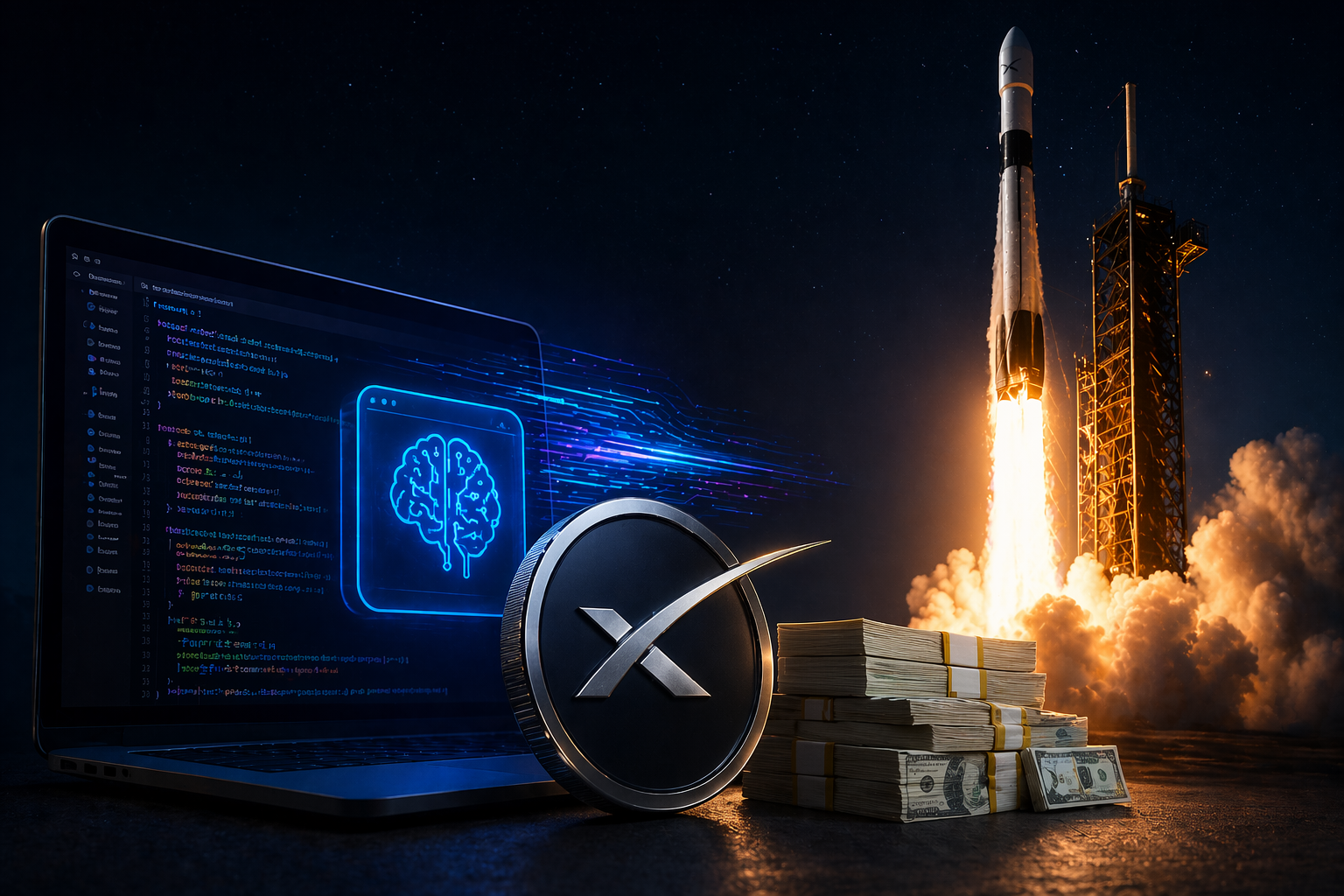
SpaceX, Elon Musk’s rocket and space company, announced a partnership with Cursor, a fast-growing AI-powered code editor. The deal includes an option for SpaceX to buy Cursor outright for $60 billion later this year. If SpaceX decides not to buy, it will still pay $10 billion just for the collaboration. Either way, that’s a staggering amount of money for a company most people outside the tech industry haven’t heard of yet.
Cursor is a code editor, which is the software that programmers use to write their programs. Think of it like Microsoft Word, but for code. What makes Cursor special is that it has AI built right into the editing experience. As developers type, Cursor suggests what to write next, catches mistakes in real time, and can even generate entire sections of code from a plain English description of what you want the program to do.
The company behind Cursor is called Anysphere, founded in 2022 by four MIT students: Michael Truell, Sualeh Asif, Arvid Lunnemark, and Aman Sanger. In just a few years, they’ve built a tool that hundreds of thousands of software engineers now use daily. Cursor is based on Visual Studio Code, the world’s most popular code editor (made by Microsoft), so it feels immediately familiar to most developers while adding a powerful AI layer on top.
What’s interesting is that Cursor doesn’t rely on its own AI models for everything. It currently uses models from Anthropic (makers of Claude) and OpenAI (makers of ChatGPT) to power many of its features. That detail matters a lot when you consider why SpaceX is getting involved.
This is where it gets interesting. SpaceX isn’t just about rockets anymore. In February 2026, Elon Musk merged SpaceX with xAI, his artificial intelligence startup, in a deal valued at $1.25 trillion. xAI is the company behind Grok, Musk’s AI chatbot. So “SpaceX” is now really a combined space-and-AI company with enormous computing resources.
Specifically, SpaceX has Colossus, a massive AI training supercomputer in Memphis, Tennessee, that the company says has computing power equivalent to a million Nvidia H100 chips. That’s a truly enormous amount of processing power, and it’s the key to this deal.
Here’s the strategic picture: Cursor currently depends on AI models made by Anthropic and OpenAI. But both of those companies are now building their own coding tools that compete directly with Cursor. Anthropic has Claude Code, and OpenAI recently launched Codex. So Cursor finds itself in an awkward position: its best features run on technology made by companies that are actively trying to replace it.
Partnering with SpaceX gives Cursor access to Colossus so it can train its own AI models. Cursor CEO Michael Truell said he’s “excited to partner with the SpaceX team to scale up Composer,” referring to the company’s own AI model. The goal is clear: stop depending on competitors for the technology that makes your product work.
The deal structure is unusual. SpaceX isn’t buying Cursor right now. Instead, it has secured an option to purchase the company for $60 billion at some point before the end of 2026. If SpaceX decides not to exercise that option, it pays $10 billion for the partnership work they’re doing together. For Cursor, it’s a win either way: they get a massive payday or a massive acquisition, and in the meantime they get access to one of the world’s most powerful AI training facilities.
To put that $60 billion number in perspective, Cursor was in talks to raise venture capital funding at a $50 billion valuation before this deal came together. SpaceX is offering a premium on top of that. And according to CNBC, Microsoft also looked at buying Cursor in recent weeks but ultimately decided not to make an offer. That Microsoft was even interested tells you how valuable Cursor has become in such a short time.
It’s also worth knowing that two of Cursor’s senior engineers, Andrew Milich and Jason Ginsberg, recently left to join xAI directly, where they now report to Musk. That suggests the relationship between the two companies has been building for a while, and the partnership is deeper than just a financial arrangement.
The race to own the “AI for programmers” market is heating up fast. Right now, there are three main approaches. GitHub Copilot (owned by Microsoft) was the first big player and is integrated into Visual Studio Code. Anthropic’s Claude Code works directly from the command line and has become popular with professional developers. OpenAI recently launched Codex as its own coding assistant. And Cursor sits in the middle, offering what many developers consider the best actual editing experience, while relying on other companies’ models under the hood.
The SpaceX deal could shift this dynamic significantly. If Cursor successfully trains its own competitive models using Colossus, it would become the only major AI coding tool that controls both the product experience and the underlying AI. Everyone else either makes the model but is new to building coding tools (Anthropic, OpenAI), or has the tool but relies on someone else’s models (which was Cursor’s situation until now).
For everyday users who are just starting to explore AI, the takeaway is simple: AI-powered coding tools are becoming so important that rocket companies are spending tens of billions of dollars to own one. Software development is one of the first industries being genuinely reshaped by AI, and the tools programmers use to write code are at the center of an enormous business battle.
This deal is also happening against the backdrop of SpaceX preparing for what could be the largest IPO in history, expected in June 2026. Having a leading AI coding platform in the portfolio makes SpaceX look like more than a launch provider. It positions the company as a serious player in the broader AI economy, which matters a lot when you’re trying to attract public market investors.
For Cursor’s four young founders, it’s a remarkable outcome. A company started by MIT students just four years ago is now at the center of a $60 billion tug-of-war between the world’s biggest tech companies. Whether SpaceX ultimately buys Cursor or simply funds the partnership, the AI coding market is about to get a lot more competitive.
And if you’re someone who has ever thought about learning to code, tools like Cursor are making it more accessible than ever. The AI doesn’t write perfect code on its own, but it acts like a patient, always-available assistant that can explain what’s happening, suggest fixes, and help you build things faster than you could alone. That’s exactly the kind of practical AI progress worth paying attention to.